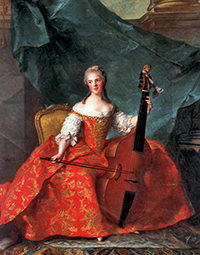
A musical instrument as an implementation of artistic gesture: cello
DOI:
https://doi.org/10.32405/2308-8885-2024-2(112)-2-6Keywords:
cello, artistic gesture, sound image, music of the 20th century, advanced techniquesAbstract
The series “The sound image of the instrument in the 20th century” article highlights the sound image of the cello as one of the wealthiest musical instruments in terms of its possibilities in the context of its interpretation as an artistic gesture - a mark aimed at the effect of a socio-cultural act of form and content.
The outstanding role of suites for solo cello by I. S. Bach, who first revealed the instrument's possibilities and demonstrated its cantilene, virtuosic, and polyphonic capabilities, is pointed out. An example of a bright socio-cultural gesture is the creation of the Musical Garden in Canada, parts of which are associated with Bach’s cello suites. Examples of an individual approach to the sound of the cello and the creation of a particular extraordinary soundscape in the works of composers of the 20th century, M. Skoryk, J. Kram, M. Feldman, and H. Lachenman, are given. As an example of an original interpretation of the cello, the Cello Concerto No. 1 by Myroslav Skoryk is indicated, in which the cello is interpreted as the voice of a lyrical hero, and its dialogue with the orchestra is very diverse, which creates an exciting intrigue of the musical action. Gyorgy Ligeti can be considered a master of gesture: after graduating from the F. Liszt Academy of Music in Budapest, the author created the piece Dialogo for solo cello. In 1953, the composer made the second part of this work for the cellist Vera Denesh, which led to the design of the sonata for the cello. Ligety claimed that this is a dialogue between a woman and a man. In work "Cello and Orchestra (1972) by Morton Feldman, the author gives the cello overexpression against the background of the loud sound of the orchestra, which is on the border with alarming noise and declares complete submission to the sound of his own ideas. Helmut Lachenmann interprets the instruments as “geographical” objects: yes, the strings have “poles”, the role of which is played by the stand and pegs, the strings are given the role of "meridians", and the bow is a “parallel”.
It is indicated that the cello, like the entire body of musical instruments, received so-called “advanced techniques” that enriched its sound and became the basis for performing various roles in solo and ensemble performances. The article presents the images of the cello in other forms of art, which proves the concrete-historical context of its perception and poetization in the art of different eras.
References
Briukhovetska, O. (2022). Symvolichnyi zhest chy vybukh nesvidomoho [Symbolic gesture or explosion of the unconscious]. Kino, teatr.
Zhuk, H. (2004). Violonchelna muzyka Vasylia Barvynskoho v konteksti rozvytku zhanru v ukrainskii muzytsi na pochatku XX stolittia [Cello music of Vasyl Barvynskyi in the context of the development of the genre in Ukrainian music at the beginning of the 20th century]. Muzychna ukrainistyka i svitovyi kontekst, 51-58.
Zakhodiakin, A. (2021). Zhanr instrumentalnoho kontsertu u tvorchosti Myroslava Skoryka (na materiali kontsertu N 1. dlia violoncheli z orkestrom) [Instrumental concerto genre in the work of Myroslav Skoryk (based on the material of Concerto No. 1 for Cello and Orchestra)]. Chasopys Natsionalnoi muzychnoi akademii Ukrainy imeni P. I. Chaikovskoho, 2(51), 122-136.
Ostrovskyi, S. (2024). Novi metody formuvannia zvukovysotnosti na strunno-smychkovykh instrumentakh iz vykorystanniam rozshyrenykh tekhnik [New methods of pitch formation on stringed and bowed instruments using advanced techniques]. Slobozhanski mystetski studii, 1(04), 83-93.
Pohoretskyi, Yu. (2023). Modyfikatsiia violonchelnoho vykonavstva v suchasnomu vektori rozvytku [Modification of cello performance in the modern vector of development]. Slobozhanski mystetski studii, 3, 58-62.
Sumarokova, V. (2010). Violonchelne mystetstvo v konteksti neo- ta polistylistyky XX – pochatku XXI stolittia: Refleksiia i dyskurs [Cello art in the context of neo- and polystylistics of the 20th – the early 21st centuries: Reflection and discourse]. Aktualni problemy mystetskoi praktyky i mystetstvoznavchoi nauky, 3, 178-185. Retrieved from http://nbuv.gov.ua/UJRN/apmpmn_2010_3_33
Vucofzer, M. F. (1947). Music in the Baroque Era: from Monteverdi to Bach. New York.
Janof, T. (1995). A survey of Bach Suite Editions. Internet Cello Society. Retrieved from http://www.cello.org/Newsletter/Articles/jsbach.html
Feldman, M. (2006). Morton Feldman Says: Selected Interviews and Lectures 1964–1987 / ed. by Chris Villars. London: Hyphen Press.
Lachenmann, N. 1996. Musik al.s existentielle Erfahrung: Schriften 1966-1995. Wiesbaden: Breitkopf/Härtel.
Strange, P., & Strange, A. (2001). The Contemporary Violin: Extended Performance Techniques. Lanham, MD: Scarecrow Press.
Taruskin R. (1995, January-February). Six Times Six: A Bach Suite. Selection Strings, 9(4), 117–121.